
State Bank of India, Adani Ports, Tata Consultancy Services, ICICI Bank, Reliance Industries and PowerGrid were also among the laggards.

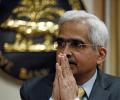
The RBI under former governor Shaktikanta Das resisted pressures to cut interest rates through 2024 as it kept its 'Arjuna's eye' trained on inflation, but the central bank under a new detail-oriented head will soon have to take a call if it can continue sacrificing growth. Das, a career bureaucrat who in 2016 oversaw Prime Minister Narendra Modi's highly disruptive demonetisation move, left a lasting legacy as he demitted office towards the end of 2024 after expertly navigating monetary policy for six years, the highlight of which was steering India's recovery through the pandemic.

The share of equity and investment funds in the total financial wealth of households increased by more than 50% between 2011-2012 and 2022-2023.
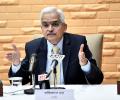
RBI Governor Shaktikanta Das on Wednesday replied to the 'history major central bank governor' taunt faced by him, questioning if Argentinian football legend Lionel Messi is also a post-graduate in history. An interviewer anchoring a fireside chat at a summit organised by Business Standard compared his position to an opponent facing Messi at a football arena in Qatar, to which Das replied with wit. "Don't mind it, but was Messi also a post-graduate in history? Not often, but I am sometimes reminded by people that I am supposed to have done history," Das said.

The Reserve Bank on Wednesday approved a Rs 2.11 lakh crore dividend payout to the central government for 2023-24, more than double the amount it paid for the previous 2022-23 financial year. The decision was taken at the 608th meeting of the Central Board of Directors of the Reserve Bank of India held under the chairmanship of Governor Shaktikanta Das.

At a time when the government is nudging the private sector to ramp up its capital expenditure (capex), the Ministry of Statistics and Programme Implementation (MoSPI) is poised to kick-start the first-of-its-kind annual survey on the status of private sector capex from next month. "The inaugural edition of the annual exercise will start in October and will be completed by December. "The results will be made public by February next year," said Geeta Singh Rathore, director general, National Sample Survey Office (NSSO), at a data users' conference on Thursday.

"I mentioned to sir (Ratan Tata) that the son of a fellow army officer was handicapped below the waist and needed a job," he told PTI from Pune where he now lives. "Vijay Bisht, son of my then colleague in M&G area HQ Lt Col B S Bisht, had sustained severe leg injuries after falling from a horse and I came to know he was looking for a job," he added. Tata said the needful would be done. And it was.

The Financial Intelligence Unit-India (FIU-India), the national agency responsible for analysing suspicious financial transactions, has received requests from four more offshore crypto exchanges to operate in India again, said a senior government official familiar with the matter. In the beginning of 2024, India had banned nine crypto exchanges - Binance, Kucoin, Huobi, Kraken, Gate.io, Bitstamp, MEXC Global, Bittrex, and Bitfenix - for non-compliance with anti-laundering law in the country.
The Reserve Bank of India on Wednesday decided to keep the policy rate unchanged for the tenth time in a row but changed its stance to 'neutral' that may lead to a cut in the forthcoming policies. RBI maintained status quo despite the US Federal Reserve lowering the benchmark rates by 50 basis points last month.

The RBI on Wednesday slashed key interest rate by 25 basis points, for the second time in a row, to support a shuttering economy hit by reciprocal tariffs imposed by the US. Following the rate cut, the key policy rate eased to 6 per cent providing relief to home, auto and corporate loan borrowers.

Reserve Bank on Thursday retained the growth and inflation projection at 7.2 per cent and 4.5 per cent respectively for the current fiscal amid expectations of a normal monsoon. In its last bi-monthly monetary policy review in June, RBI had projected real GDP growth and retail inflation at the same.
Reserve Bank Governor Shaktikanta Das on Wednesday said the decision to tweak policy rates was not in his hand as he himself is driven by the situation on the ground. In April, the Reserve Bank in a surprise move hit the pause button and decided to keep the key benchmark policy rate at 6.5 per cent. Prior to it, the Reserve Bank of India (RBI) was on a rate hiking spree, raising the repo rate by 250 basis points since May 2022.

The RBI on Thursday said banks' gross NPA ratio has fallen to a sever-year low of 5 per cent and the banking system remains sound and well-capitalised. In the 26th issue of the Financial Stability Report (FSR), the RBI also said the global economy is facing formidable headwinds with recessionary risks looming large. The interplay of multiple shocks has resulted in tightened financial conditions and heightened volatility in financial markets, it pointed out.

From the Sensex pack, Power Grid, Mahindra & Mahindra, JSW Steel, HCL Technologies, Sun Pharma, Nestle, IndusInd Bank, Reliance Industries, Bharti Airtel and ITC were the major laggards. Tech Mahindra, Wipro, Bajaj Finance, State Bank of India, Bajaj Finserv, Axis Bank, Titan and ICICI Bank were among the major gainers.

The Reserve Bank of India (RBI) on Friday hiked repo rate by 50 basis points to 5.90 per cent in order to control the rising inflation, keeping in line with the aggressive policies of central banks and the volatile markets prevalent across economies. RBI Governor Shaktikanta Das announced the rate hike today. In the meeting of the Monetary Policy Committee (MPC) that started on Wednesday, five of the members of the MPC voted to hike the key lending rate, repo rate, by 50-basis points (bps).

IT and interest rate-sensitive bank, realty, and auto stocks ended with sharp gains.
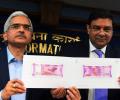
PAC summons RBI Governor Urjit Patel, Finance Secretary Ashok Lavasa and Economic Affairs Secretary Shaktikanta Das.
The Reserve Bank of India (RBI) has barred four non-banking finance companies (NBFCs), including two microfinance institutions (MFIs), from sanctioning and disbursing loans for charging exorbitant interest rates to the borrowers. These four entities are Asirvad Microfinance, Arohan Financial Services (also an MFI), DMI Finance, which provides personal, consumption, and micro, small and medium enterprises loans, and Flipkart co-founder Sachin Bansal's Navi Finserv, which offers home and personal loans. The ban will take effect on October 21 to "facilitate closure of transactions in the pipeline", the regulator said in a statement.

As many as 80-85 per cent Paytm wallet users will not face any disruption because of regulatory actions, and the remaining users have been advised to link their apps to other banks, RBI Governor Shaktikanta Das said on Wednesday. The Reserve Bank of India on January 31 barred Paytm Payments Bank Ltd (PPBL) from accepting deposits, credit transactions, or top-ups in any customer accounts.
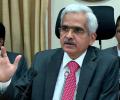
Das favoured shifting the stance of monetary policy from neutral to accommodative to send a clear signal, indicating that more measures could be taken in the near future to boost growth.
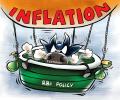
The Reserve Bank of India on Thursday marginally lowered its inflation projection for the current financial year to 5.1 per cent, as Governor Shaktikanta Das said the central bank's monetary policy actions are yielding the desired results. In April, the Reserve Bank had estimated the consumer price index (CPI) based retail inflation at 5.2 per cent during the fiscal 2023-24. CPI inflation fell sharply to 4.7 per cent in April 2023, from 6.4 per cent in February, on the back of favourable base effects, with softening observed across all the three major groups.

"All restrictions have been removed except on savings bank account of Rs 24,000 per week. This (removal of withdrawal limit) is also a matter of time," Economic Affairs Secretary Shaktikanta Das said.
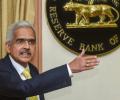
Financial markets are under stress and require steps by the central bank for market stability and revival of economic growth, he said while announcing the decisions taken by the Monetary Policy Committee in Mumbai.

The Reserve Bank on Wednesday projected retail inflation to ease to 5.3 per cent in next fiscal from 6.5 per cent this year on assumptions of lower imported inflation, even though core inflation remains sticky. The RBI's inflation outlook for current fiscal has improved from 6.8 per cent projected earlier, to 6.5 per cent, on the back of steeper than expected decline in vegetable prices and Indian basket of crude at $95 a barrel. "Looking ahead, while inflation is expected to moderate in 2023-24, it is likely to rule above the 4 per cent target.
Key lending rate (repo) raised by 50 basis points to 4.9 per cent; 2nd increase in 5 weeks

Dr Nagesh Kumar, one of the three new MPC members, wanted the MPC to reduce the repo rate by 25 basis points to 6.25%.
200 staffers, consisting of RBI officials and support teams, who are essential to perform critical functions, were isolated at a separate facility in a dedicated quarantined environment near all three RBI data centres.

Prime Minister Narendra Modi on Tuesday expressed hope that digital transactions will soon surpass cash as Unified Payments Interface (UPI) is increasingly becoming the most preferred payment mechanism in the country. Modi after the launch of the cross-border connectivity between the UPI and PayNow of Singapore said about 74 billion transactions amounting to more than Rs 126 trillion, which is approximately 2 trillion Singapore dolla, was done through UPI in 2022. "Many experts are estimating that very soon India's digital wallet transactions are going to overtake cash transactions," he said.

Bank account holders are no longer required to visit their bank branches to update 'know your customer' (KYC) details provided they have already submitted valid documents and not changed their address, the RBI has said. Instead, if there is no change in KYC information, they can submit a self-declaration through email-id, registered mobile number, ATMs, or any other digital channels. Following up on Reserve Bank Governor Shaktikanta Das stating that banks should not insist on branch visits for KYC updation, the central bank on Thursday issued guidelines for the same.

The Reserve Bank of India on Thursday kept the benchmark interest rate unchanged at 4 per cent and decided to continue with its accommodative stance against the backdrop of an elevated level of inflation.

Wholesale inflation fell to a 3-month low of 2.04 per cent in July on decline in prices of food items especially vegetables, government data released on Wednesday showed. The decline in wholesale price index (WPI) based inflation in July came after it rose for four months in a row till June, when it was 3.36 per cent. It was (-) 1.23 per cent in July last year. In April wholesale inflation stood at 1.19 per cent.

At the PMO, policies are framed by factoring in analytical perspectives, implications, sustainability, and other dimensions.
Available data obscures the true stress in bank books, and the pandemic will result in balance sheet impairments and capital shortfalls at lenders, RBI Governor Shaktikanta Das said on Monday. Balance sheet impairment and capital shortfalls will be more evident once the regulatory reliefs are rolled back, Das said in the bi-annual Financial Stability Report, asking lenders to augment capital.

'A mule operates someone else's account to transfer illegal money.'
Reserve Bank of India (RBI) on Friday said its board has approved a dividend payment of Rs 30,307 crore to the government for the financial ended March 2022. The board approved the transfer of Rs 30,307 crore as surplus to the central government for the accounting year 2021-22 while deciding to maintain the Contingency Risk Buffer at 5.50 per cent, RBI said in a statement. The decision on the dividend payment was made in the 596th meeting of the Central Board of Directors of RBI, headed by Governor Shaktikanta Das, held on Friday.
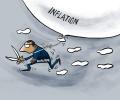
Most members of the Reserve Bank of India's monetary policy committee (MPC) decided to stick to the course on bringing retail inflation to the target of 4 per cent while voting for maintaining status quo in the April review, except external member Jayanth Varma who voted for a 25 bps cut in the repo rate. "I believe that the extant monetary policy setting is well positioned," RBI governor Shaktikanta Das said in the minutes of the policy review, which came out on Friday. "Monetary policy transmission is continuing and inflation expectations of households are also getting further anchored.

The RBI on Friday said the impact of coronavirus outbreak on the economy will depend on the intensity, spread and duration of the deadly virus even as the central bank refrained from projecting any numbers for growth and inflation amid the widespread uncertainty. While announcing the seventh bi-monthly monetary policy statement for 2019-20, RBI Governor Shaktikanta Das said that in view of the impact of coronavirus pandemic, the growth projections for 4.7 per cent for the fourth quarter of 2019-20 and 5 per cent for the full fiscal are "now at risk".

After raising interest rate by a cumulative 250 basis points in 11 months, the Reserve Bank of India (RBI) on Thursday unexpectedly kept benchmark rate unchanged as global banking woes added uncertainty to the economic outlook. Five out of six members of MPC voted to remain focused on the withdrawal of accommodation to ensure inflation aligns with target while focusing on growth, RBI Governor Shaktikanta Das said on Thursday. The Monetary Policy Committee of the central bank decided to take a pause after a rate hike seen in previous six consecutive policies.

The banking system liquidity bounced back to surplus mode after three weeks, the Reserve Bank of India (RBI) data showed. This was due to government spending, according to dealers. The liquidity situation could further ease with the disbursement of the last tranche of incremental cash reserve ratio (I-CRR) worth Rs 50,000 crore on Saturday.
Uncertainty is emerging as the only certainty, said RBI Governor Shaktikanta Das as he emphasised on continued policy support at the December MPC meet during which members expressed concerns over spread of the Omicron variant of coronavirus, as per the minutes of the rate-setting panel released on Wednesday. After three days of deliberations, the six members of the Monetary Policy Committee (MPC) on December 8 unanimously voted for status quo on policy rates for the ninth consecutive time. At the meeting, the RBI Governor said risks stalking the global economy have amplified with rapid spread of the virus mutations, including the Omicron variant, leading to countries scrambling for restrictions.
